Table of Contents
In many web applications, developers attempt to enhance login security by encrypting passwords on the client side before sending them to the server. A common approach is to use AES encryption in JavaScript and transmit the encrypted password to the backend.
While this may appear secure at first glance, it introduces a critical security concern: the encryption key itself is often exposed within the frontend application.
In this article, we’ll explore why client-side AES encryption is not the ideal approach for password transmission and how Public Key Encryption provides a more secure alternative.
The Problem with Frontend AES Encryption
AES is a symmetric encryption algorithm, meaning the same key is used for both encryption and decryption.
In a typical implementation:
- The user enters a password.
- The frontend encrypts the password using an AES key.
- The encrypted value is sent to the server.
- The server decrypts the password using the same AES key.
The challenge is that the browser must have access to the AES key in order to perform encryption. Since JavaScript code is delivered to the user’s browser, the key can potentially be viewed, extracted, or reverse engineered.
This means that anyone with access to browser developer tools can inspect the application and retrieve the encryption key used to protect passwords.
Why This Is a Security Risk
When the encryption key is exposed:
- Attackers can replicate the encryption process.
- Encrypted payloads can potentially be decrypted if the key is compromised.
- The security of the entire mechanism depends on a secret that is no longer secret.
- The implementation provides limited protection beyond what HTTPS already offers.
In short, client-side AES encryption creates a false sense of security because the encryption key is distributed to every user of the application.
A Better Alternative: Public Key Encryption
Public Key Encryption, also known as asymmetric encryption, uses two separate keys:
- Public Key – Used for encryption.
- Private Key – Used for decryption.
Unlike symmetric encryption, the public key can be safely shared with users because it cannot decrypt data.
How It Works
- The server generates a public/private key pair.
- The public key is shared with the frontend.
- The user’s password is encrypted using the public key.
- The encrypted password is sent to the server.
- The server decrypts the password using the private key.
Since the private key never leaves the server, an attacker cannot decrypt the transmitted password even if they have access to the frontend application.
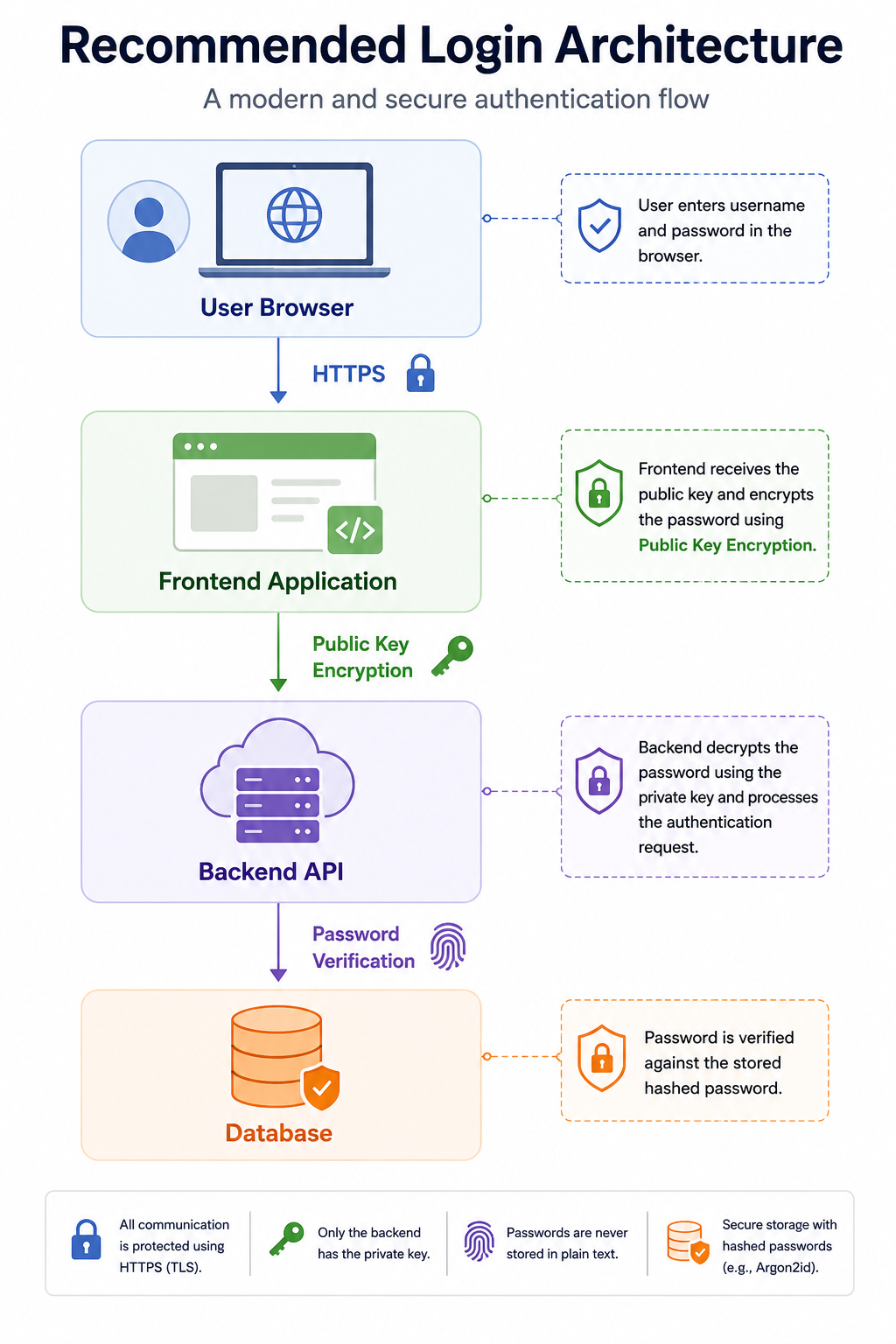
This architecture combines transport security, encryption, and secure password storage practices.
Password Storage: Encryption Is Not Enough
A common misconception is that encrypted passwords should be stored in the database.
In reality, passwords should never be stored using reversible encryption.
Instead, they should be stored using one-way password hashing algorithms.
Recommended Password Hashing Algorithms
The current industry-recommended choice is:
- Argon2id
Alternative options include:
- bcrypt
- PBKDF2
These algorithms are specifically designed to protect passwords against brute-force and dictionary attacks.
Why Hashing Is Better Than Encryption
Encryption can be reversed if the key is compromised.
Hashing is a one-way operation.
This means:
Password → HashBut:
Hash → Passwordis computationally impractical.
Even if an attacker gains access to the database, properly hashed passwords remain significantly more difficult to crack.
Additional Security Best Practices
Always Use HTTPS
HTTPS remains the primary layer of protection for credentials transmitted over the internet.
Even when implementing Public Key Encryption, HTTPS should always be enforced.
Organizations should use:
- TLS 1.2 or higher
- Preferably TLS 1.3
Use Unique Salts
Every password should be hashed with a unique random salt.
This prevents attackers from using precomputed rainbow tables and makes password cracking substantially more difficult.
Consider Using a Pepper
In addition to salts, organizations may implement a server-side pepper stored separately from the database.
A pepper provides an additional layer of protection if the password database is ever compromised.
Protect Against Replay Attacks
Authentication systems should validate:
- Nonces
- Timestamps
- Session identifiers
These controls help prevent attackers from reusing previously captured login requests.
Key Takeaways
Client-side AES encryption may appear to improve login security, but exposing the encryption key in browser code significantly weakens its effectiveness.
Public Key Encryption offers a stronger model by ensuring that only the server can decrypt sensitive information. When combined with HTTPS and modern password hashing algorithms such as Argon2id, organizations can build authentication systems that align with current security best practices.
For businesses developing enterprise applications, the recommended approach is straightforward:
- Use HTTPS for all communication.
- Replace client-side AES encryption with Public Key Encryption.
- Store passwords using Argon2id hashing.
- Implement proper key management and replay attack protection.
Conclusion
Security is not achieved by adding more encryption—it is achieved by using the right encryption in the right place.