
Table of Contents
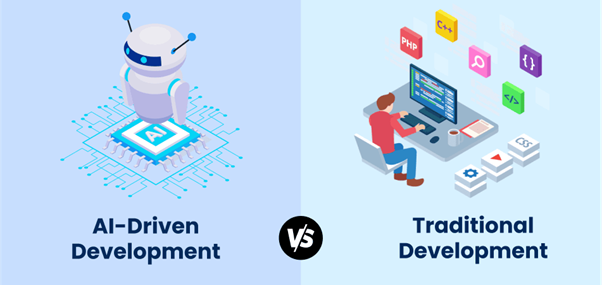
Software development has evolved from manual coding to working with intelligent AI tools. With tools like GitHub Copilot and ChatGPT, developers now build applications faster and smarter. This shift is not about replacing developers, but transforming how software is created.
What is Traditional Development?
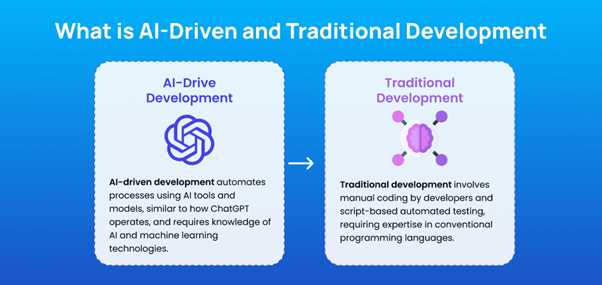
Traditional development is the approach where developers:
- Write code manually
- Debug errors themselves
- Design logic without external intelligence
- Rely on documentation, experience, and search engines
Workflow
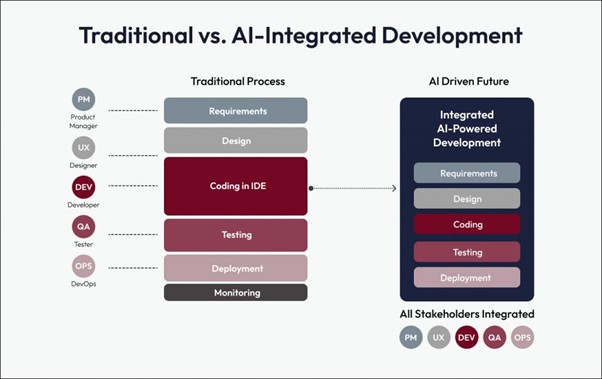
Requirement → Design → Code → Debug → Test → Deploy
What is AI-Assisted Development?
AI-assisted development involves using AI tools to:
- Generate code
- Suggest fixes
- Explain logic
- Automate repetitive tasks
Developers give instructions (prompts), and AI helps produce solutions.
Workflow
Requirement → Prompt → AI Suggestion → Refine → Deploy
Key Differences (Traditional vs AI-Assisted Development)
-
Coding:
Traditional → Manual coding
AI-Assisted → AI + manual coding -
Speed:
Traditional → Slower
AI-Assisted → Faster -
Debugging:
Traditional → Done manually
AI-Assisted → AI helps in fixing errors -
Productivity:
Traditional → Limited
AI-Assisted → Highly increased
Speed vs Depth
AI-assisted development focuses on speed, allowing tasks that once took hours to be completed in minutes. It helps developers quickly generate code and solutions.
On the other hand, traditional development emphasizes deep understanding, where developers manually write and debug code, leading to stronger concepts and problem-solving skills.
Risks of AI
- AI can generate incorrect or misleading code.
- It may miss edge cases or special scenarios.
- AI does not fully understand business logic or requirements.
- Over-reliance on AI can reduce developer learning and skills.
- Developers should not blindly trust AI output — always review and test.
Hybrid Approach
The best approach is to combine both traditional and AI-assisted development.
- Use traditional methods for logic, design, and deep understanding
- Use AI tools for speed, automation, and productivity
This combination helps developers build faster and smarter applications.
Conclusion
Traditional development builds strong fundamentals, while AI-assisted development improves speed and efficiency. Both approacheshave their own strengths and limitations. The most effective way is to combine them, using traditional methods for deep understanding and AI tools for faster execution.
As technology evolves, developers need to adapt by learning how to work with AI rather than relying on it blindly. By balancing knowledge and automation, developers can create smarter, more efficient, and high-quality software.