
Table of Contents
In modern software engineering, “system design” Has evolved from a niche concern of senior engineers into a fundamental skill expected across the board. It is no longer enough to simply write code that works; the real challenge lies in building systems that continue to work under stress, scale gracefully as demand increases, and remain maintainable as complexity grows. In 2026, the expectations from software systems are higher than ever—users demand speed, reliability, and seamless experiences regardless of scale. This makes system design the backbone of any successful application.
Whether you are building apis with fastapi, orchestrating background jobs with celery, or managing structured data in mysql, understanding architectural principles is essential. Behind every high-performing system lies a thoughtful design that balances trade-offs between performance, scalability, complexity, and cost. This blueprint revolves around four key pillars: Architecture style, data management, asynchronous processing, and scalability strategies.
1. The Great Debate: Microservices vs. Monoliths
Every project begins with a simple but critical question: should you build one powerful, all-in-one application, or break it into smaller, specialized services? This decision isn’t just technical—it shapes how your product grows, how your team collaborates, and how your system behaves under pressure.
Let’s start with the monolith. Imagine a single codebase where everything lives together—authentication, billing, user management, APIs, background jobs—all in one place. It’s clean, straightforward, and incredibly efficient in the early days. You don’t have to think about network calls between services, version mismatches, or distributed failures. You write code, test it, deploy it—and you’re done.
That’s why monoliths are perfect for startups, MVPs, and small teams. When speed matters more than scale, simplicity wins. You can iterate faster, fix bugs quickly, and keep your focus on building features instead of managing infrastructure. But as your application grows, cracks begin to show. The codebase gets heavier, deployments take longer, and even a small change can impact the entire system. Scaling becomes an all-or-nothing game.
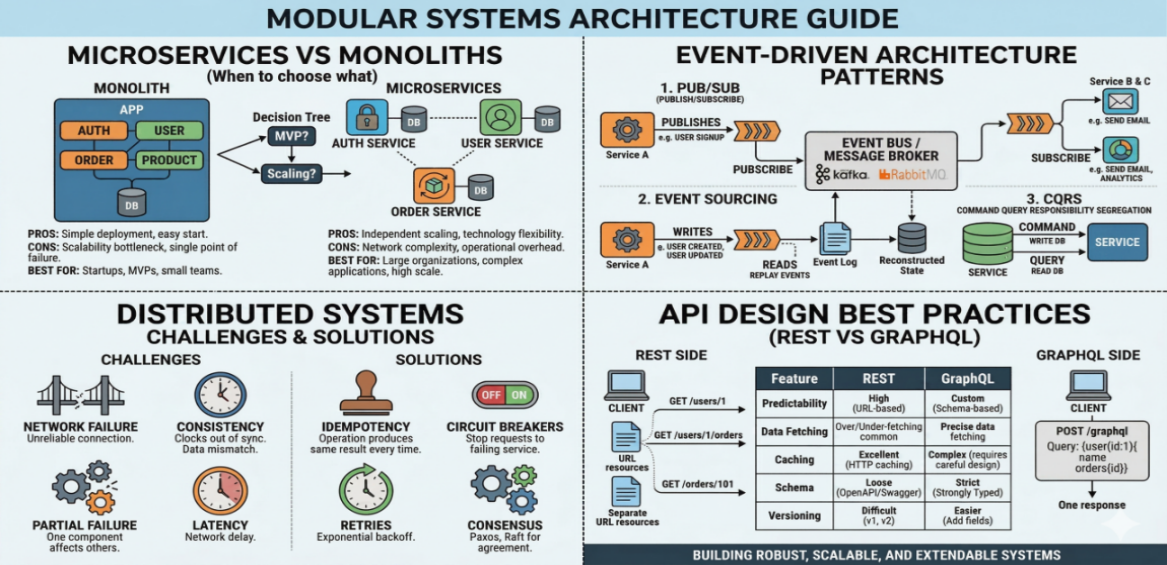
Now enter microservices. Instead of one big application, you break your system into smaller, independent services. Each service has a single responsibility and communicates with others over APIs. This approach gives you flexibility—teams can work independently, deploy changes without affecting others, and scale only what’s needed.
Sounds perfect, right? Not quite.
Microservices come with their own challenges. You now have to deal with network latency, service discovery, monitoring, failure handling, and data consistency across services. What was once a simple function call inside a monolith is now a network request that can fail in unpredictable ways.
That’s why jumping straight into microservices can be a mistake.
A smarter approach? Start with a modular monolith. Structure your codebase with clear boundaries between components, even though everything runs as a single application. This gives you the best of both worlds—simplicity today and flexibility tomorrow. When your system grows and the need arises, you can gradually extract services without rewriting everything from scratch.
2. Visualizing Modern Architecture
To understand how these pieces fit together, refer to the guide below. It covers the flow from simple services to complex event-driven communication.
3. Event-Driven Architecture (EDA)
In a modern stack, your API shouldn’t do everything. If a user signs up, your API shouldn’t make them wait while it sends a welcome email and generates a PDF.
How it works: Your FastAPI app sends a “Task” to a broker (like RabbitMQ or Redis).
The Worker: A background worker (like Celery) picks up the task and executes it independently.
The Result: Your user gets an instant response, and the heavy lifting happens in the background.
4. Challenges in Distributed Systems
When you move to distributed systems, you encounter “The Three C’s”:
- Consistency: Does every database have the same info at the same time?
- Complexity: Monitoring 10 services is harder than monitoring one.
- Cascading Failures: If your “Auth” service goes down, does it kill the whole site?
Solution: Use Circuit Breakers. If a service is failing, stop sending it requests to give it room to recover.
5. API Design: REST vs. GraphQL
How should your frontend talk to your backend?
REST: The classic. It’s simple, uses standard HTTP codes, and is the native way FastAPI works. It’s great for 90% of use cases.
Summary Checklist for Your Next Project
| Feature | Recommendation |
|---|---|
| Framework | FastAPI (for speed and type safety) |
| Task Queue | Celery (for event-driven background work) |
| Message Broker / Event Bus | RabbitMQ (for robust routing) or Redis (for fast queues) |
| Database | MySQL (for structured, reliable data) |
| Architecture | Start Monolithic, scale to Microservices |
Final Thought
Good architecture is about making decisions that are easy to change later. Build clean, write tests, and don’t over-engineer until the data tells