Table of Contents
Introduction
Maintaining balance between electricity generation and consumption is one of the most critical responsibilities in the power sector. Even small variations between scheduled and actual power generation or consumption can impact grid stability and operational efficiency.
To address this challenge, the Deviation Settlement Mechanism (DSM) was introduced as a regulatory framework that encourages grid discipline and ensures reliable power system operations.
DSM plays a crucial role for power generators, distribution companies (DISCOMs), renewable energy producers, traders, and utilities by monitoring deviations and imposing charges for non-compliance.
In this guide, we explain what DSM is, how it works, its importance, regulations, challenges, and how DSM software can help organizations maintain compliance while reducing financial penalties.
What is Deviation Settlement Mechanism (DSM)?
The Deviation Settlement Mechanism (DSM) is a regulatory framework used to manage the difference between scheduled electricity and actual electricity injected into or drawn from the power grid.
When a generating station, renewable energy plant, or distribution utility deviates from its approved schedule, charges are applied according to predefined regulatory guidelines.
The primary objectives of DSM are:
- Maintain grid stability
- Encourage accurate forecasting and scheduling
- Improve operational discipline
- Reduce frequency fluctuations
- Promote efficient power system operations
Why is DSM Important in the Power Sector?
DSM is essential because electricity cannot be stored economically at large scale in conventional grids. Supply and demand must remain balanced in real time.
Benefits of DSM include:
Improved Grid Reliability
DSM helps maintain system frequency within acceptable limits and supports secure grid operation.
Better Forecasting Accuracy
Organizations are encouraged to improve forecasting and scheduling practices.
Reduced Operational Risks
Utilities can identify potential deviations before they become costly issues.
Financial Discipline
DSM introduces accountability by linking deviations to financial consequences.
Renewable Energy Integration
Solar and wind generators can improve forecasting and minimize uncertainty through effective DSM management.
How Does the Deviation Settlement Mechanism (DSM) Work?
The DSM process generally involves the following steps:
1. Power Scheduling
Generators and utilities submit power schedules in advance.
2. Real-Time Operation
Actual generation and consumption are continuously monitored.
3. Deviation Measurement
The difference between scheduled and actual energy is calculated.
4. Settlement Calculation
Deviation penalties and receivables are determined according to applicable regulations.
5. Reporting and Compliance
Organizations review performance and take corrective actions to improve future scheduling accuracy.
Who is Affected by DSM?
DSM regulations impact multiple stakeholders, including:
- Power Generating Companies
- Renewable Energy Developers
- Solar Power Producers
- Wind Power Producers
- Distribution Companies (DISCOMs)
- State Load Dispatch Centres (SLDCs)
- Regional Load Dispatch Centres (RLDCs)
- Power Traders
- Independent Power Producers (IPPs)
Common Causes of DSM Deviations
Several factors contribute to power deviations:
Forecasting Errors
Inaccurate load or generation forecasts can lead to schedule mismatches.
Renewable Energy Variability
Solar irradiance and wind conditions can change unexpectedly.
Equipment Failures
Unexpected outages may affect generation output.
Transmission Constraints
Grid congestion can impact power delivery.
Load Variations
Consumer demand may fluctuate significantly during peak periods.
DSM Challenges Faced by Utilities and Power Producers
Many organizations struggle with:
- Manual deviation calculations
- Delayed reporting
- Multiple data sources
- Regulatory compliance requirements
- Lack of real-time monitoring
- Difficulty identifying root causes of deviations
These challenges often result in increased penalties and operational inefficiencies.
How DSM Software Helps Reduce Deviation Penalties
Modern DSM software enables organizations to manage deviations proactively through automation and analytics.
Key capabilities include:
Real-Time Monitoring
Track generation, consumption, and deviations continuously.
Automated DSM Calculations
Eliminate manual errors and improve accuracy.
Forecasting and Scheduling Support
Improve planning through advanced analytics.
Compliance Management
Stay aligned with evolving regulatory requirements.
Reporting and Dashboarding
Generate comprehensive reports for operational teams and management.
Alerts and Notifications
Receive instant alerts when deviation thresholds are exceeded.
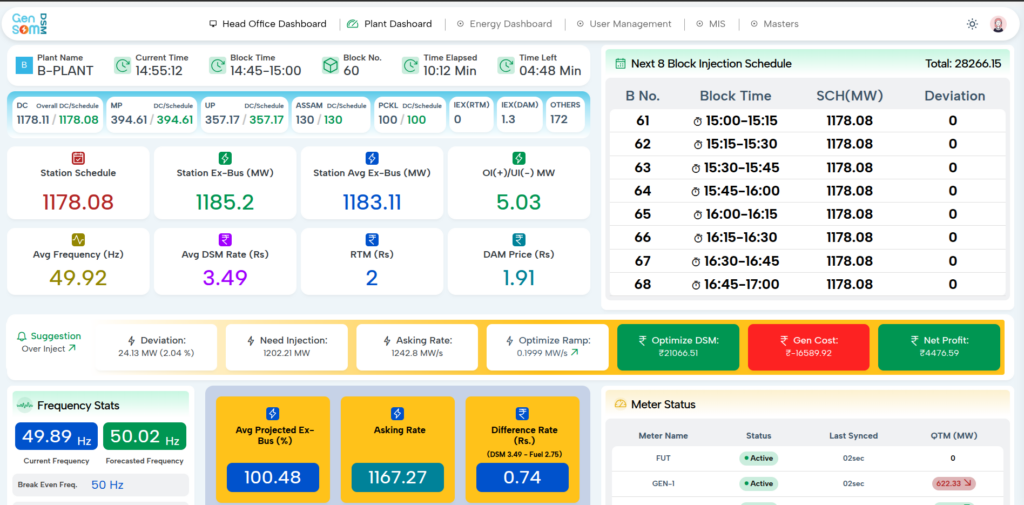
GenSOM DSM: Intelligent DSM Management Software
Organizations looking to improve compliance and reduce deviation settlement mechanism (DSM) penalties can leverage GenSOM DSM, a comprehensive deviation management solution designed for the power sector.
Key benefits include:
- Real-time deviation monitoring
- Automated DSM calculations
- Forecasting support
- Compliance reporting
- Performance analytics
- Centralized operational visibility
Related Solution
If you also operate solar power assets, explore GenSOM Solar, Sharajman’s solar plant monitoring and asset management platform, designed to improve generation forecasting, operational performance, and renewable energy compliance.
Best Practices for Effective DSM Management
Improve Forecast Accuracy
Use advanced forecasting models and weather data integration.
Monitor Operations in Real Time
Continuous monitoring helps identify issues before penalties occur.
Automate Compliance Reporting
Reduce manual effort and reporting delays.
Analyze Historical Trends
Use historical data to improve scheduling performance.
Adopt DSM Software
Automation significantly improves visibility and compliance management.
Future of DSM in the Power Sector
As renewable energy penetration increases, deviation settlement mechanism frameworks will become even more important. Advanced analytics, AI-driven forecasting, and automated compliance platforms will help utilities and generators maintain grid discipline while optimizing operational performance.
Organizations that invest in digital DSM solutions today will be better prepared for future regulatory and operational requirements.
Conclusion
The Deviation Settlement Mechanism (DSM) is a vital component of modern power system operations. It promotes grid stability, operational discipline, and accurate forecasting while ensuring accountability across the electricity value chain.
As regulatory requirements become more stringent and renewable energy adoption continues to grow, utilities, generators, and power producers need advanced DSM software solutions to monitor deviations, improve compliance, and minimize penalties.
Platforms like GenSOM DSM provide the visibility, automation, and analytics required to manage deviations effectively and support reliable grid operations.
For the latest DSM regulations and scheduling guidelines, refer to the official Central Electricity Regulatory Commission (CERC) and GRID-INDIA websites.
FAQ Section (Schema Recommended)
What is the deviation settlement mechanism (DSM) in the power sector?
DSM (Deviation Settlement Mechanism) is a regulatory framework that manages deviations between scheduled and actual electricity generation or consumption.
Why is DSM important?
DSM helps maintain grid stability, improve forecasting accuracy, and reduce operational risks.
Who needs DSM software?
Power generators, DISCOMs, renewable energy developers, IPPs, power traders, and utilities can benefit from DSM software.
How are DSM charges calculated?
DSM charges are calculated based on the magnitude of deviation and applicable regulatory guidelines.
How can DSM penalties be reduced?
Organizations can reduce penalties through better forecasting, real-time monitoring, and automated DSM management software.