
Table of Contents
Modern cloud infrastructure starts with a strong and secure network foundation, and in AWS, that foundation is the Virtual Private Cloud (VPC). Whether you’re building a startup application, enterprise platform, SaaS solution, or hybrid cloud architecture, understanding AWS VPC components is essential for designing scalable, secure, and highly available environments.
What is AWS VPC?
Amazon Virtual Private Cloud (VPC) allows organizations to create their own isolated network inside AWS. It gives full control over IP ranges, routing, internet access, security, and connectivity with on-premises infrastructure.
A well-designed VPC architecture improves the following:
- Security
- High Availability
- Scalability
- Network Isolation
- Hybrid Connectivity
- Performance Optimization
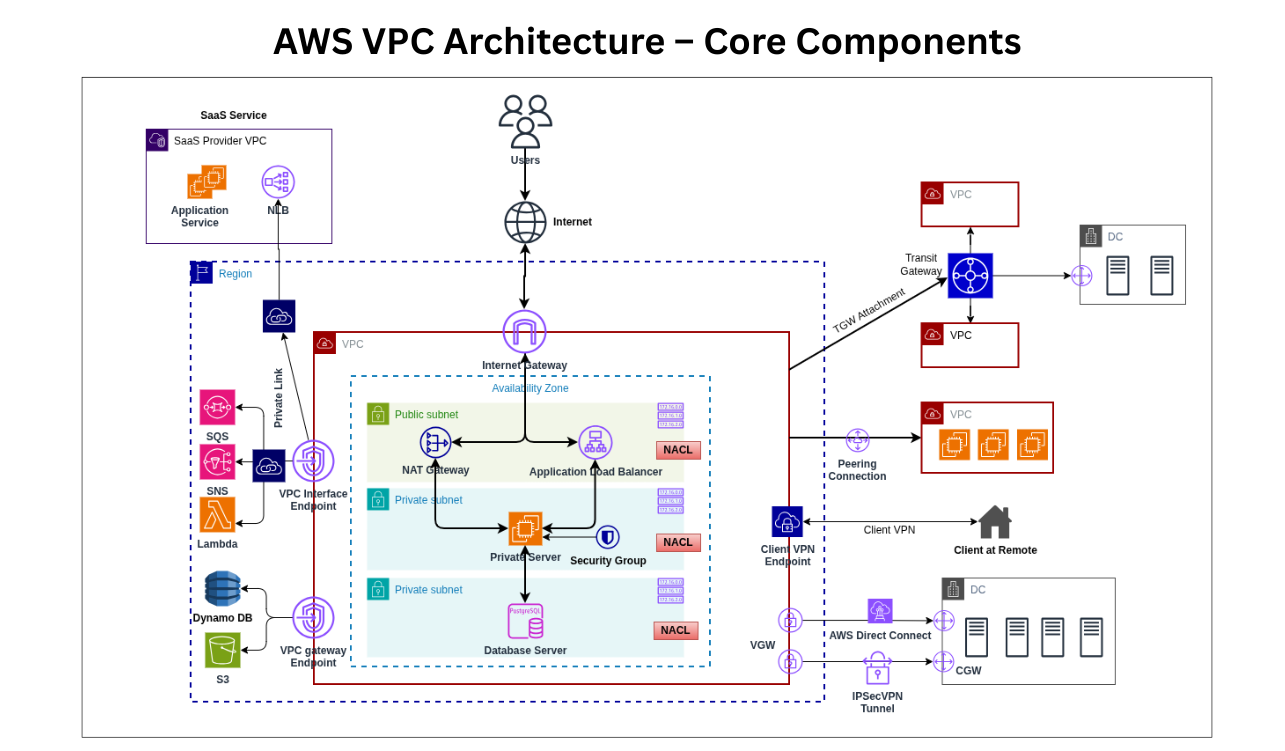
Major Components of AWS VPC Architecture
1. VPC (Virtual Private Cloud)
A VPC is the primary networking layer in AWS where all cloud resources are deployed.
It acts like a private data center in the cloud, allowing organizations to define their own network boundaries, IP ranges, and security rules.
Common Use Case:
Hosting production applications securely in isolated cloud environments.
2. Availability Zone (AZ)
Availability Zones are isolated AWS data centers within a Region.
Deploying applications across multiple AZs ensures high availability and fault tolerance during failures.
Common Use Case:
Running multi-AZ applications for disaster recovery and business continuity.
3. Subnets – Public & Private
Subnets divide the VPC into smaller logical sections.
Public Subnet
Resources inside public subnets can communicate with the internet through an Internet Gateway.
Example:
Application Load Balancers, Bastion Hosts, Public Web Servers.
Private Subnet
Private subnets do not allow direct inbound internet access.
Example:
Database Servers, Backend APIs, Internal Services.
4. VPC CIDR & Subnet CIDR
CIDR blocks define the IP address ranges for VPCs and subnets.
Proper CIDR planning is critical to avoid IP conflicts in hybrid and multi-cloud environments.
Example:
- VPC CIDR → 10.0.0.0/16
- Public Subnet → 10.0.1.0/24
- Private Subnet → 10.0.2.0/24
5. Internet Gateway (IGW)
An Internet Gateway enables internet communication for resources inside public subnets.
Without an IGW, public-facing applications cannot receive external traffic.
Common Use Case:
Hosting websites, APIs, and internet-facing applications.
6. NAT Gateway
A NAT Gateway allows private subnet resources to access the internet securely without exposing them publicly.
Common Use Case:
Private servers downloading software updates or patches securely.
7. Route Tables
Route Tables control traffic flow within the VPC.
They determine where network packets should be directed.
Common Use Case:
Routing traffic to Internet Gateways, NAT Gateways, VPNs, or Transit Gateways.
8. Network ACL (NACL)
NACL is a subnet-level security layer that filters inbound and outbound traffic.
It acts as a stateless firewall.
Common Use Case:
Blocking suspicious IP ranges or restricting subnet-level access.
9. Security Group
Security Groups provide instance-level security and act as virtual firewalls.
Unlike NACLs, Security Groups are stateful.
Common Use Case:
Allowing SSH, HTTP, HTTPS, or database access only from trusted sources.
10. AWS VPN Gateway (VGW)
A Virtual Private Gateway enables secure communication between AWS and on-premises infrastructure.
Common Use Case:
Hybrid cloud connectivity between enterprise data centers and AWS.
11. AWS Customer Gateway (CGW)
Customer Gateway represents the physical or software VPN device located on-premises.
It works together with the Virtual Private Gateway.
Common Use Case:
Connecting office networks securely to AWS environments.
12. AWS PrivateLink
AWS PrivateLink enables private connectivity to AWS services and SaaS applications without using the public internet.
Common Use Case:
Secure communication with third-party SaaS providers.
13. VPC Interface Endpoint
Interface Endpoints use private IP addresses to connect privately with AWS services.
Common Use Case:
Accessing services like:
- SQS
- SNS
- Lambda
- CloudWatch
without internet exposure.
14. VPC Gateway Endpoint
Gateway Endpoints provide private access specifically to:
- Amazon S3
- DynamoDB
Common Use Case:
Secure S3 access from private EC2 instances without NAT Gateway costs.
15. Transit Gateway
Transit Gateway acts as a centralized networking hub connecting:
- Multiple VPCs
- VPNs
- On-premises networks
Common Use Case:
Large enterprise architectures requiring centralized connectivity management.
16. AWS VPC Peering
VPC Peering allows two VPCs to communicate privately.
Traffic never passes through the public internet.
Common Use Case:
Connecting shared services VPC with application VPCs.
17. Client VPN Endpoint
AWS Client VPN allows remote users to securely access AWS resources.
Common Use Case:
Remote employee access for secure enterprise connectivity.
18. AWS Direct Connect
AWS Direct Connect provides dedicated private network connectivity between AWS and on-premises infrastructure.
It offers lower latency and more stable performance than internet-based VPNs.
Common Use Case:
Enterprise workloads requiring high-speed secure connectivity.
19. IPSec VPN Tunnel
IPSec VPN creates encrypted tunnels over the public internet.
It ensures secure communication between AWS and external networks.
Common Use Case:
Secure site-to-site connectivity for hybrid cloud deployments.
Key Takeaways
VPC isn’t just networking—it’s your security perimeter
Every AWS workload lives inside a VPC. Understanding how these 19 components fit together—from the CIDR block you define on day one to the Transit Gateway that scales your enterprise—is foundational to building secure, scalable cloud architectures.