
Table of Contents
What is Data?
Data is often called the oil of the 21st century because of the vital role it plays in modern organizations. It consists of raw facts, figures, or observations collected from various sources that can be processed to generate meaningful information.
In today’s digital world, data is generated continuously through systems, transactions, sensors, and online interactions. Whether stored in databases or data warehouses, understanding how data is collected and managed is essential for effective analysis.
Organizations increasingly rely on data to support decision-making, uncover patterns, and drive innovation. However, the real competitive advantage comes not from simply collecting data, but from interpreting it effectively.
Successful leaders therefore shift their focus from asking “What data do we have?” to asking “What insights is the data revealing?”
1. The “So What” Factor: Storytelling as the Power Behind Influence
Collecting data is only the first step. The real value of analytics comes from answering the most important question:
“So what does this data actually mean?”
Raw data by itself rarely drives decisions. Leaders need clear insights, not spreadsheets full of numbers.
For example, reporting that sales dropped by 12% last quarter is simply data.
Explaining that the drop was caused by a pricing change and reduced marketing spend turns that data into insight.
This is where data storytelling becomes essential.
Data storytelling combines analysis, context, and communication to explain:
- what happened
- why it happened
- why it matters
- what action should be taken
When insights are communicated effectively, they help decision-makers quickly understand the implications and take informed action.
In other words, successful analytics does not end with charts or dashboards—it ends with better decisions and measurable business impact.
Organizations that master this skill turn data from a technical asset into a strategic advantage.
2. Shifting from Looking Back to Looking Ahead: The Four Levels of Analytics
To make smarter strategic decisions, leaders must move beyond simply reviewing past performance and adopt forward-looking, action-oriented analytics. This progression helps organizations reduce risk and navigate complex situations with greater confidence.
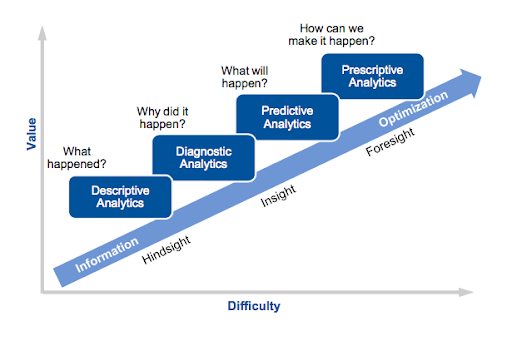
Descriptive Analytics — What happened?
This stage focuses on summarizing historical data to understand past performance. For example, a company might analyze last year’s seasonal sales highs and lows to identify overall trends.
Diagnostic Analytics — Why did it happen?
At this stage, analysts examine relationships and patterns within the data to uncover underlying causes. For example, a Discounted Cash Flow (DCF) valuation model may help connect variations in cash flow to changes in revenue streams.
Predictive Analytics — What will happen?
Predictive analytics uses historical data and statistical models to anticipate future outcomes. It works similarly to a weather forecast, warning organizations about potential trends—such as projecting project costs over the next five years.
Prescriptive Analytics — What should we do?
This is where organizations gain a true strategic advantage. If predictive analytics signals a potential challenge ahead, prescriptive analytics recommends the best course of action.For example, businesses can test “what-if” scenarios such as:
- Adjusting pricing strategies to maximize revenue
- Optimizing marketing campaigns to target the right customers
- Improving demand forecasting to avoid inventory shortages or overstock
By evaluating different possible actions before making a decision, organizations can reduce risk and choose strategies that deliver the best business outcomes.
3. The Reliability Trap: Why “Clean Rooms” Outperform “Big Data”
Organizations often fall into the trap of valuing data quantity over data quality. However, unrefined data is like a cluttered room—without proper organization and cleaning, it is difficult to rely on what you find inside.
Data must be cleansed, validated, and transformed before it becomes reliable for analysis. Trustworthy data forms the foundation of meaningful analytics. Without this trust, even the most insightful analysis may fail to gain executive confidence.
Forward-thinking organizations are now focusing on Data Observability, which involves continuous monitoring of data pipelines to detect inconsistencies and maintain reliability.
Pro Tip: Data delivers value only when it is both trusted and acted upon. Dependability is the core of analytics—without it, even the most advanced models and insights will fail to support decisive, confident leadership.
4. The Intuition Hybrid: Why Algorithms Still Require Human Judgment
While data is extremely valuable, it does not tell the entire story on its own. The most effective organizations build a data-informed culture, rather than relying solely on a data-driven approach.
Algorithms are excellent at identifying patterns and trends, but they cannot fully account for business context, ethical considerations, market dynamics, or regulatory requirements. This is where human expertise becomes essential.
Combining analytical insights with human judgment ensures that decisions are both technically sound and practically viable.
“When analytical insights are combined with human experience and judgment, decision-making becomes significantly stronger—adding depth and perspective that algorithms alone may overlook.”
5. ROI in Practice: How Market Leaders Convert Data into Growth
Many global organizations have successfully transformed data into measurable business growth.
Amazon
Uses advanced recommendation systems that account for roughly 35% of its overall revenue, while also leveraging real-time analytics to optimize logistics operations.
Netflix
Analyzes viewer behavior to guide content creation and acquisition decisions. Today, nearly 80% of streaming activity is influenced by its data-driven recommendation system.
Walmart
Uses AI-enabled inventory management systems to continuously monitor stock levels, helping reduce excess inventory while preventing shortages.
Uber
Improves customer experience by analyzing live traffic and demand signals to efficiently connect riders with nearby drivers and reduce wait times.
Conclusion: The Rise of the Data-Empowered Leader
The business world is rapidly moving toward data democratization. With the rise of no-code platforms and AI/ML tools, much of the technical complexity behind analytics is being automated.
As a result, leadership responsibility is shifting from how data is processed to how insights are interpreted and applied strategically.
In today’s environment, the critical question is no longer how much data an organization can store. Instead, it is whether the organization is simply collecting data—or truly understanding and acting on the insights it reveals.